Have questions or want to report an issue? Email radar@bostonartreview.com

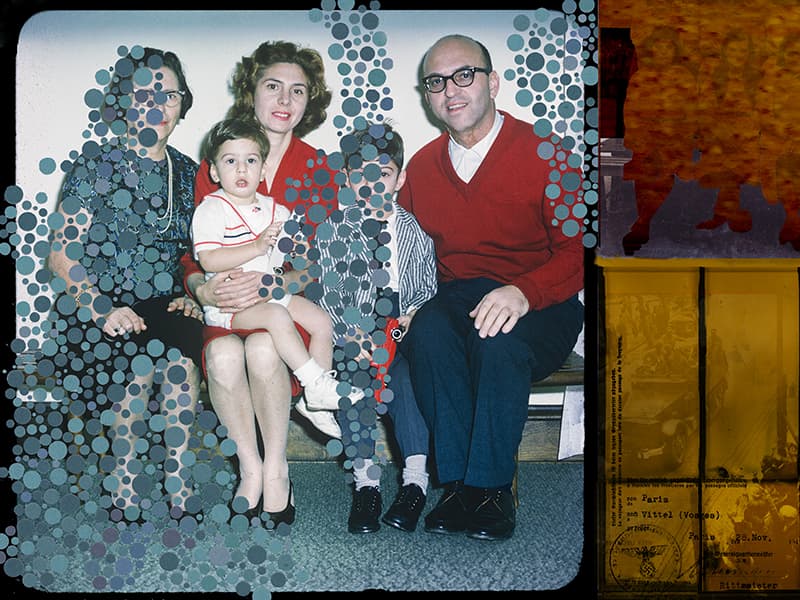
re•cognition
The impetus for this body of work came while watching my daughter and her high school friends celebrate her sixteenth birthday. At the time, I had been working with photographs from my mother's history as a Holocaust survivor in France, and I came upon an image that was deeply familiar to me: a class picture of my mother taken at about the same age.
Suddenly, the class picture assumed a profoundly different meaning. I experienced a kind of emotional palimpsest, seeing my mother's image through the present-day experience of my daughter gathered with her friends. For the first time, I recognized that many of the girls pictured with my mother—her classmates in the 11th arrondissement of Paris, all about sixteen years old—were likely to have perished during the Holocaust.
Through this present-day reflection, I peeled back another layer of my mother's story. For the first time, I tried to imagine not the survivor she would become, but the ordinary sixteen-year-old girl she had been—with classmates, friendships, and an unknowable future. The school photograph became a catalyst, prompting me to recognize a dimension of her life that had remained outside my own understanding. In that moment, I realized that I had been insulated from my mother's history by my own assumptions as much as by her silence.
My mother lived with an enduring emotional dichotomy: the traumatic history she carried—and largely shielded me from—and the new life she built after immigrating to the United States. Re•Cognition arrose from the tension between these two realities. It is an attempt to recognize, in both senses of the word, a history that was always present yet only became through the experience of another generation. The work explores how recollection is continually reconstituted as the present reshapes our understanding of the past. Re-cognition is the moment when an image, though unchanged, yields a different understanding.