Have questions or want to report an issue? Email radar@bostonartreview.com

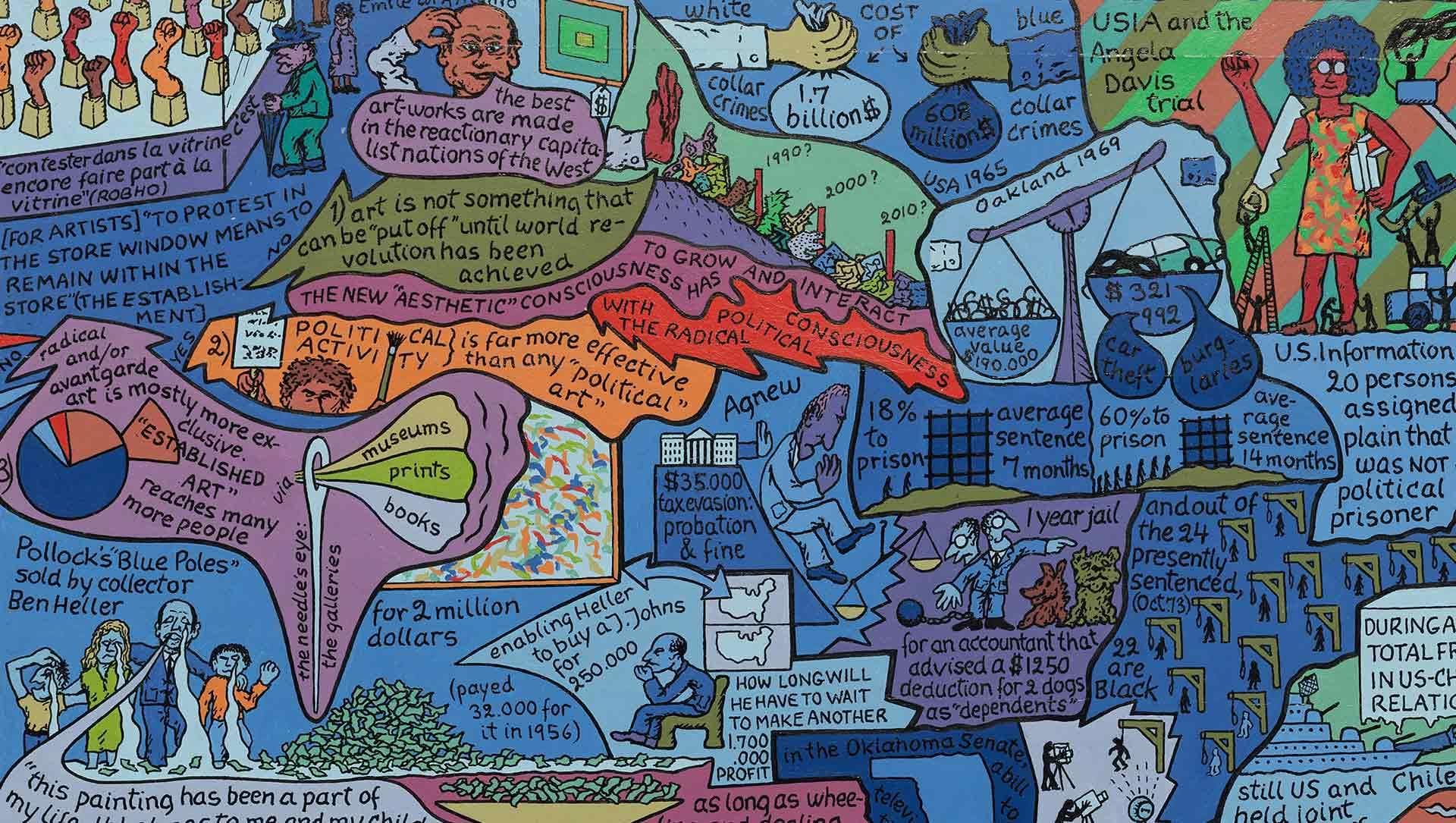
Active in the United States during the politically charged 1960s and ’70s, Öyvind Fahlström (1928–1976) created a body of work that both invites audience participation and supplies biting political commentary, reflecting his understanding of art as “a fusion of ‘pleasure’ and ‘insight.’” This exhibition explores the artist’s career through a range of deceptively playful multimedia works—many assuming the form of games or cartoons—that push visitors to consider their own role in politics and society.
Fahlström was born in São Paulo, Brazil, to Scandinavian expatriate parents, and grew up in Stockholm, Sweden. His international perspective and experiences as a poet, journalist, and critic informed his approach to art. In the early 1960s, he began to produce interactive objects with magnetic pieces that viewers could rearrange, like words in a sentence, to form new image-phrases and meanings. Ten years later, he undertook a series of colorful, cartoon-like maps—prints and drawings that trace the global flow of money and power through dense infographics.
The centerpiece of the exhibition, Fahlström’s 1966 film Mao-Hope March, documents a performance on the streets of New York, in which Fahlström and friends carry placards depicting the American comedian Bob Hope and the Chinese Communist Party chairman Mao Zedong, while a reporter asks passersby whether they are happy. Their responses connect the complex geopolitics of the Cold War era—with its clash between American capitalism, embodied by Hope, and Mao’s Communism—to personal experience, underscoring Fahlström’s belief in the necessity of participation in civic life.