Have questions or want to report an issue? Email radar@bostonartreview.com

Through Oct 10, 2026
One Wall, One Work: Shirin Neshat
Krakow Witkin Gallery
10 Newbury St 5th floor, Boston, MA 02116
Featured Artists
- Shirin Neshat
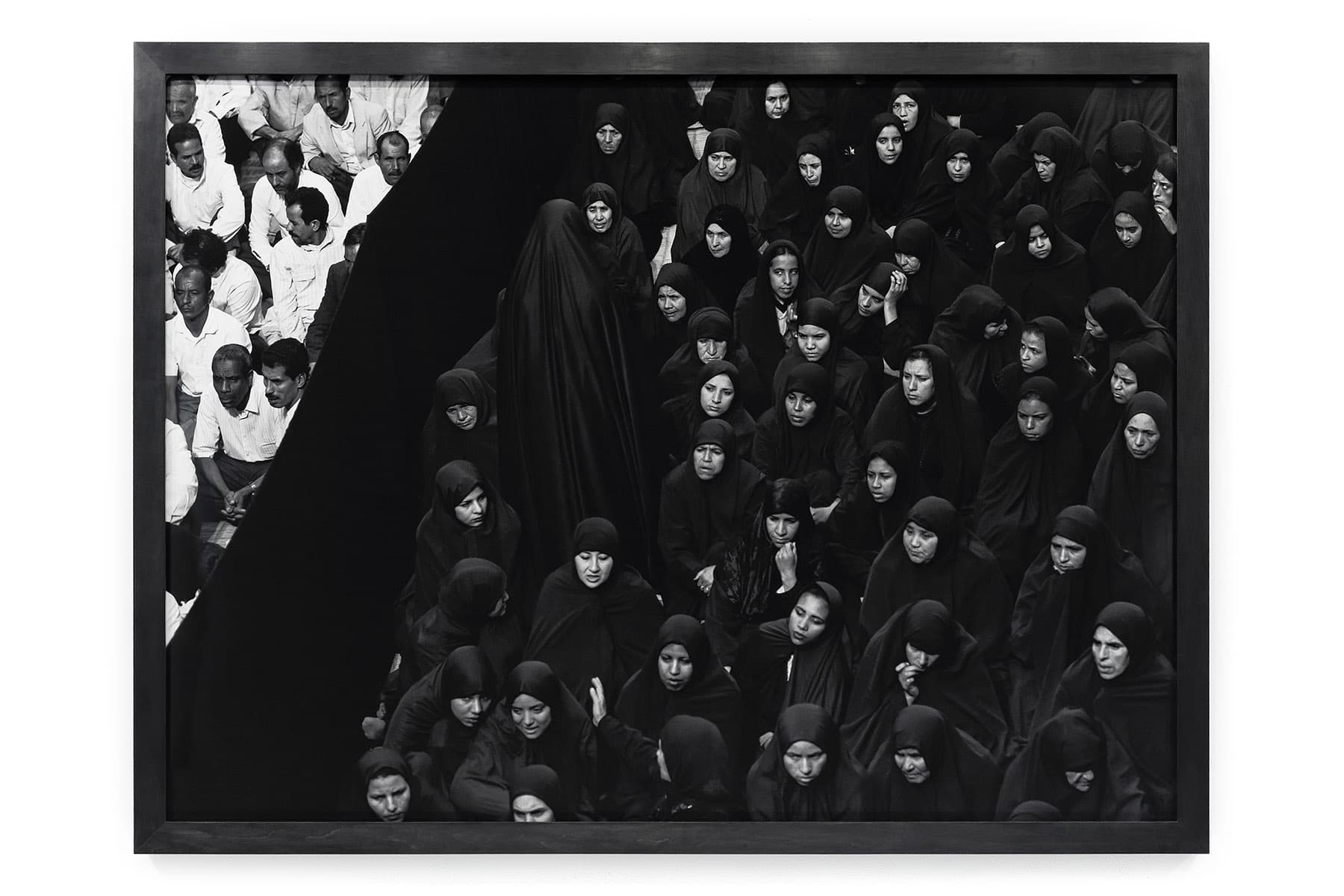
In her trilogy of films, “Turbulent,” “Rapture,” and “Fervor,” created between 1998 and 2000, Shirin Neshat chose to present each work on two screens, in such a way that the narratives unfolded simultaneously from parallel gender perspectives. Far from uniform or static, in the films and the related photographic works, Neshat’s groups of women and men bristle with individual energies and continuously reshape themselves to form webs of interrelationships, that extend between and beyond image planes to implicate the viewer in their sensually charged dynamics.
The photograph on view, from the Fervor series, “Crowd from Front, Woman Leaving” (2000), references a culminating moment of tension in the film, when adjacent male and female audiences, separated by a black curtain, have been whipped into a frenzy by an orator’s cautionary parable about sexual desire and begin to passionately curse the devil. As the crowd’s zeal builds to a climax, a single woman stands up and walks out. The solitary woman has turned her back, clad in a full-length black chador, so that she is visible less as a figure than as a void in the crowd of women seated around her.
The simple visual device enacts at once an effacement of one woman’s presence in the moment—be it a shameful escape or perhaps a cathartic liberation—and a refocusing of the viewer’s attention to the dozens of faces still turned toward the camera. The photograph, staged separately from the film, describes this moment in the vocabulary of a painting, where the narrative plays out across the image plane rather than through movement. The elevated point of view arrays the rows of women—and the men across the divide—into a silent tableau of individual gestures, conversations, and thoughts. The rigid, public edifices of moral control and political agenda fracture into a mosaic of the sensual and the private.