Have questions or want to report an issue? Email radar@bostonartreview.com

Through Mar 7, 2026
Joseph Grigely: One Wall, One Work
Krakow Witkin Gallery
10 Newbury St 5th floor, Boston, MA 02116
Featured Artists
- Joseph Grigely
Rather than making art about disability, I was making art with my disability
–Joseph Grigely
Joseph Grigely (b. 1956) was born and raised in East Longmeadow, Massachusetts. At the age of ten he fell down a hill and became completely deaf. At this point, he began a journey that he describes as “watching the world with the sound turned off,” paying close attention to language, communication, and the vagaries of human interaction. Grigely is an artist and writer whose work addresses questions about the materialization of language and communication, and the ways conversations might be represented in the absence of speech.
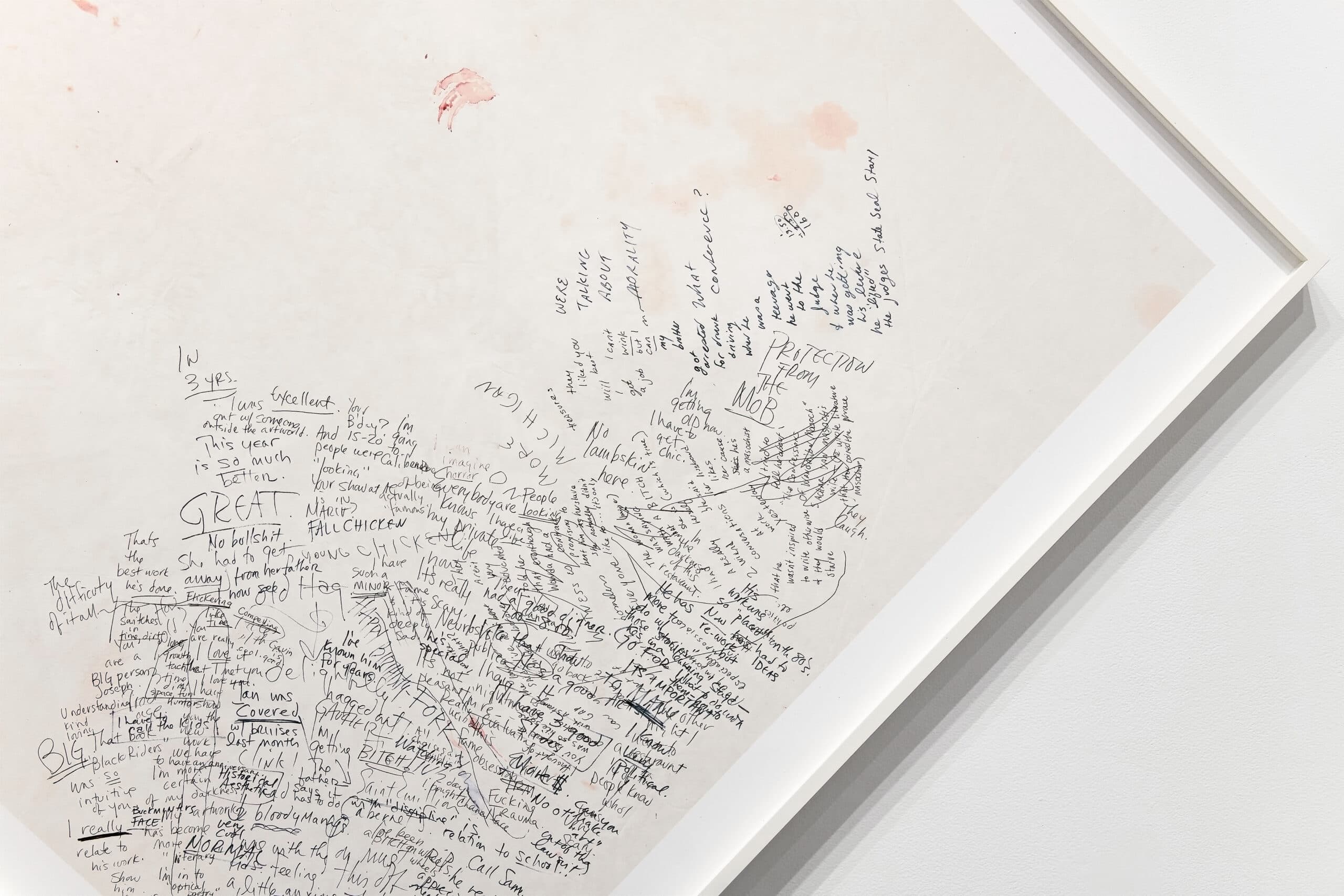
The work currently on view, “Paula's Birthday Party,” literally does what conversations around a table typically do: it turns. From one speaker on one side to another speaker on another side, and sometimes both speakers talking on top of each other. It illustrates how conversations are fragmented, layered, and how there's no fixed trajectory between the beginning and the end.
The imagery comes from a conversation—on a tablecloth, from a restaurant on Spring Street in New York City in 1996, during a birthday party for the artist Paula Hayes. Over the years, Grigely kept the cloth, but the original inks had faded, and the wine spills oxidized from red to brown. In 2016, the availability of high-resolution scanners for oversized documents meant that the tablecloth could be scanned. Through careful editing of the colors and contrast of individual lines, the work was brought back to life, and the various aspects and layers (different inks, stains, etc.) were unified as an archival pigment-based print. Furthermore, the work is hung diagonally, so that the viewer is positioned as the artist was: between two people, one on the right and one on the left. This format is also intended as a formal reference to Mondrian's diagonal paintings.