Have questions or want to report an issue? Email radar@bostonartreview.com

Through Mar 7, 2026
Julie Mehretu, Sarah Sze, and Jacques Villon
Krakow Witkin Gallery
10 Newbury St 5th floor, Boston, MA 02116
Featured Artists
- Jacques Villon
- Julie Mehretu
- Sarah Sze
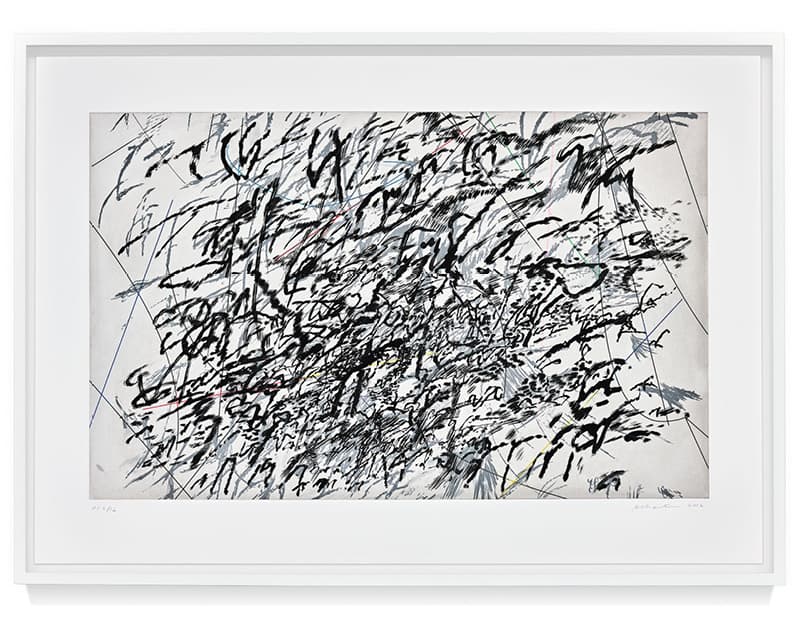
Krakow Witkin Gallery presents an exhibition of works by Julie Mehretu, Sarah Sze, and Jacques Villon. Mehretu and Sze both have active studio practices today, while Villon passed away in 1963. Perhaps an unexpected grouping, the exhibition departs from a thematic or stylistic framework to instead offer viewers the opportunity to engage deeply with three approaches to image-making, mark-making, and composition. Rather than shared history, what brings these pieces into dialogue is each artist’s individual methodology for mapping out and constructing visual space.
“Achille (epoch)” by Julie Mehretu (b. 1970, Ethiopia) is a nine-color etching with aquatint and spitbite, created in 2015. The title and the medium of this work both point toward the artist’s multi-layered practice. While Mehretu frequently works from photographic source material and uses titles that suggest a situation or narrative, the artist's imagery is inherently abstract.
Sarah Sze (b. 1969, Boston) has cultivated a practice that incorporates found objects which have, in her words, “little individual identity” into fragmented, distributed networks of relationships and interconnections, often in the form of immersive, kinetic installations. The exhibited piece, “The Moon is distant from the Sea” (2024), embodies a microcosm of Sze’s approach in tracing a connecting line across material and pictorial space.
Jacques Villon (1875 Damville, France–1963 Puteaux, France) began his career as commercial illustrator before devoting himself to painting in 1910, around the same time that he established the Puteaux group, a Cubist collective that included Robert Delaunay, Fernand Léger, Francis Picabia, and Villon’s brother Marcel Duchamp, among others. The tension between representation and pictorial abstraction would continue to be an activating force in Villon’s work throughout his career.