Have questions or want to report an issue? Email radar@bostonartreview.com

Through May 9, 2026
Damien H. Ding: After
Steven Zevitas Gallery
450 Harrison Avenue, Boston, MA 02118
Featured Artists
- Damien H. Ding
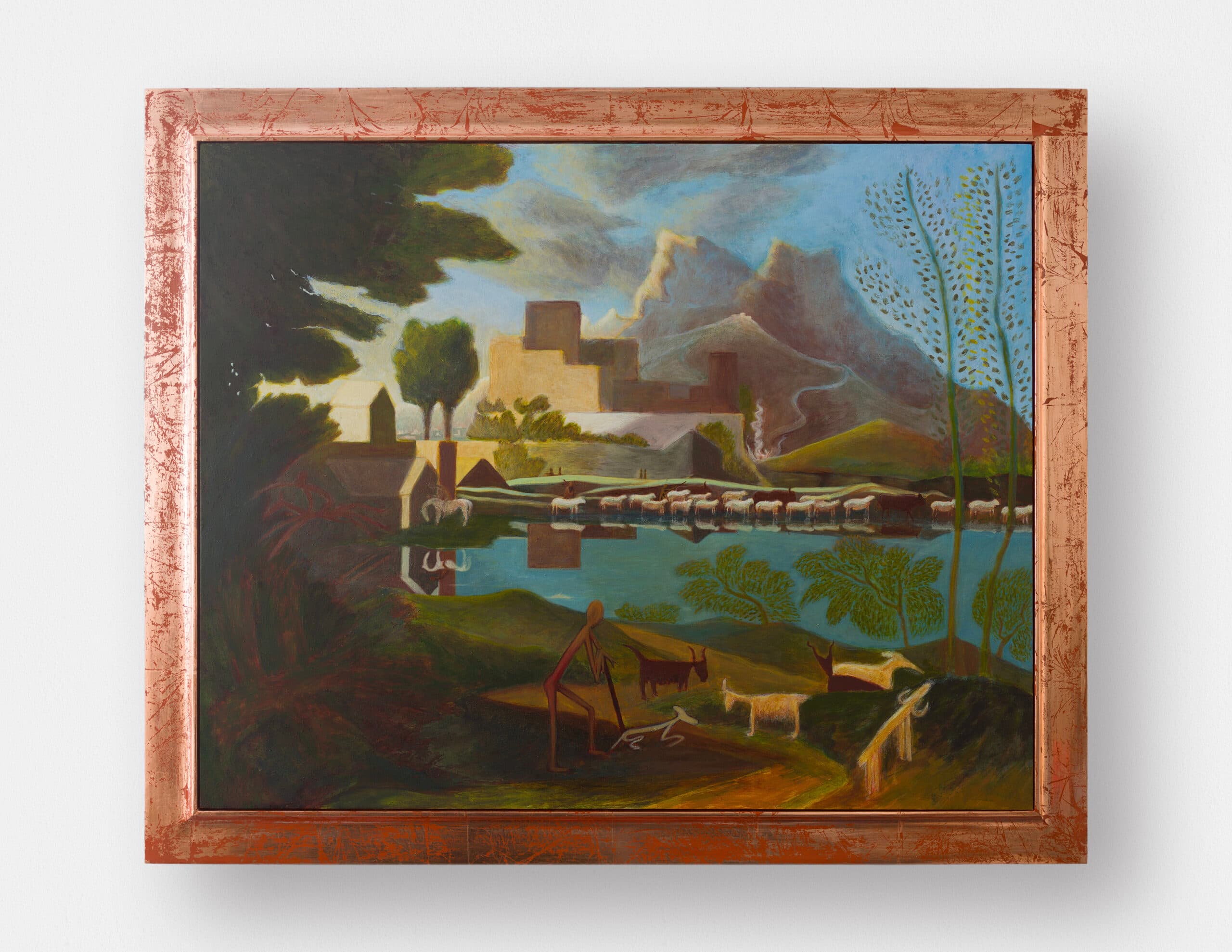
The works in After reflect on painting as both subject and method, as a practice grounded in return, revision, and sustained attention, where meaning remains provisional and in flux. These three paintings developed through Ding’s extended engagement with Landscape with a Calm by 17th-century painter, Nicolas Poussin, alongside his reading of TJ Clark’s The Sight of Death, a memoir of experimental art criticism.
In The Sight of Death, Clark records his observations across multiple viewings of two Poussin paintings at The Getty Museum: Landscape with a Calm and Landscape with a Man Killed by a Snake. Returning day after day, Clark observes how perception shifts over time, shaped by mood, attention and duration.
Ding’s process mirrors this oscillation. Moving between close study of Poussin’s work and Clark’s reflections, he continuously revised his painting in response to shifting perceptions. Through this iterative practice, Ding locates an analogy between Poussin’s suspended tensions and the act of painting itself: a space of uncertainty, negotiation, and unresolved meaning. This inquiry extends into two accompanying paintings, one of which is a self portrait.
In Self Portrait as a Stick Figure, an abstracted spindly figure stands in for the artist, at once observer and participant. The left side of the picture plane and the artist’s body begin to merge together, as his right arm lifts to paint a pastoral landscape. Are artists akin to shepherds guiding the scene, or figures on the periphery, passively fading into the ramparts and witnessing from a distance?
After ultimately considers the relationship between stillness and motion, perception and finality. While calm may suggest rest or resolution, it often exists within ongoing change. Like a pendulum pausing only at the height of its arc, the paintings inhabit a moment of suspension, poised between equilibrium and collapse.